
What Is a Digital Marketing Proposal?
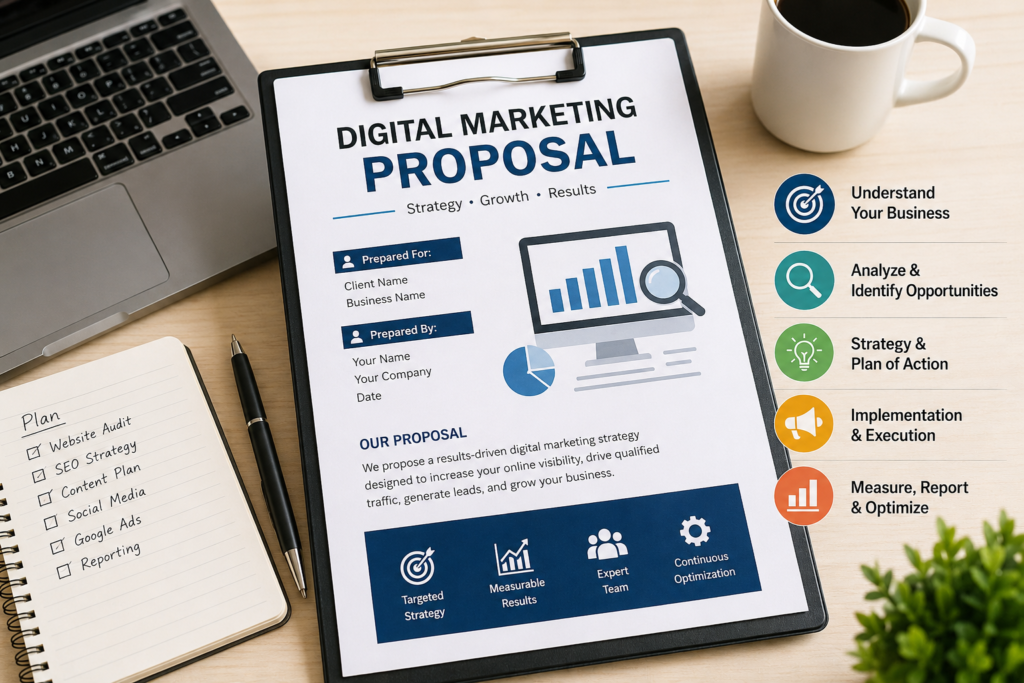
A digital marketing proposal is a professional document presented to a potential client that explains how you plan to help their business achieve its marketing goals.
It usually includes:
- Business understanding
- Current marketing situation
- Marketing objectives
- Proposed strategy
- Services and deliverables
- Timeline
- Reporting process
- Investment or pricing
- Terms and conditions
- Next steps
The purpose is simple: show the client what you will do, why it matters, and what they can expect from working with you.
Why Is a Digital Marketing Proposal Important?
Don’t begin your proposal by talking about yourself.
Start by showing that you understand the client’s business.
Research:
- Their products or services
- Target audience
- Competitors
- Website
- Social media presence
- Search visibility
- Existing advertising
- Major marketing challenges
Then summarize your findings.
For example:
Current Situation:
The business has an active website and social media presence but receives limited organic traffic and has no consistent content strategy.
This immediately shows that your proposal is customized rather than copied.
Identify the Client's Main Problems
Before recommending solutions, identify the problems.
Common digital marketing problems include:
- Low website traffic
- Poor search rankings
- Low-quality leads
- Weak social media engagement
- High advertising costs
- Low conversion rates
- Poor website experience
- Lack of content
- Weak local visibility
- Inconsistent branding
Don’t list every possible problem.
Focus on the problems that are most relevant to the client’s business.
Define Clear Marketing Objectives
Your proposal should explain what you want to achieve.
Instead of writing:
“We will improve your SEO.”
Use a more specific objective:
“Increase organic visibility for relevant commercial keywords and improve qualified organic traffic over the campaign period.”
Possible objectives include:
- Increase qualified website traffic
- Generate more leads
- Improve search visibility
- Increase conversions
- Reduce advertising costs
- Improve social media engagement
- Increase local search visibility
- Build brand awareness
Where possible, connect objectives with measurable KPIs.
Explain Your Recommended Strategy
This is one of the most important sections of the Digital Marketing Proposal.
Explain how you intend to achieve the objectives.
For example:
SEO Strategy
- Website audit
- Keyword research
- On-page optimization
- Technical SEO improvements
- Content development
- Internal linking
- Performance monitoring
Social Media Strategy
- Content planning
- Monthly content calendar
- Short-form video
- Community engagement
- Performance analysis
Paid Advertising Strategy
- Campaign structure
- Audience research
- Keyword research
- Ad-copy testing
- Landing-page optimization
- Conversion tracking
- Campaign optimization
Don’t overwhelm the client with technical terminology.
Explain the strategy in language they can understand.
Clearly Define Deliverables
A client should know exactly what they are paying for.
Create a clear deliverables section.
For example:
| Service | Deliverables |
|---|---|
| SEO | Keyword research, on-page optimization, technical recommendations, monthly reporting |
| Social Media | Content calendar, posts, captions, engagement management |
| Google Ads | Campaign setup, keyword research, ad creation, optimization |
| Content Marketing | Blog strategy, content briefs, SEO articles |
| Reporting | Monthly performance report and recommendations |
This prevents misunderstandings later.
Create a Realistic Timeline
lients want to know when the work will happen.
Instead of promising unrealistic results, create a practical timeline.
For example:
Week 1: Audit and research
Week 2: Strategy and campaign setup
Week 3: Content and optimization
Week 4: Initial performance analysis
Month 2: Optimization and expansion
Month 3: Performance review and strategy improvement
Remember that different marketing channels have different timelines.
Don’t guarantee specific rankings or unrealistic results simply to win a client.
Explain How Success Will Be Measured
A professional proposal should define the metrics that matter.
Depending on the campaign, KPIs may include:
- Organic traffic
- Search impressions
- Keyword visibility
- CTR
- Leads
- Conversion rate
- Cost per lead
- CPC
- ROAS
- Social engagement
- Website conversions
The right KPI depends on the client’s objective.
For example, an awareness campaign shouldn’t be judged exactly like a lead-generation campaign.Digital Marketing Proposal
Present Your Pricing Clearly
Starter
Suitable for small businesses beginning digital marketing.
Growth
Suitable for businesses looking for multiple marketing channels.
Premium
Suitable for businesses requiring a broader strategy and more extensive execution.
Avoid making your proposal unnecessarily complicated.
Add Your Experience and Proof
Clients want evidence that you can do the work.
Include relevant:
- Case studies
- Portfolio projects
- Client results
- Testimonials
- Certifications
- Previous campaigns
- Website projects
If you’re a beginner and don’t have client case studies, don’t invent results.
Instead, showcase personal projects, practice campaigns, website optimization projects, sample audits, and other work that demonstrates your skills.
Explain Your Reporting Process
Clients don’t want to wonder what is happening after they hire you.
Explain how you will communicate progress.
For example:
Monthly Report Includes:
- Work completed
- Key performance metrics
- Campaign results
- Important changes
- Problems identified
- Recommendations
- Next month’s priorities
You can also mention how frequently you will communicate with the client.
Clear communication can increase client confidence.
Add Terms and Conditions
Your proposal should clearly establish expectations.
Depending on your service, include:
- Payment terms
- Contract duration
- Cancellation policy
- Revision limits
- Client responsibilities
- Advertising budget responsibilities
- Communication process
- Approval timelines
- Ownership of deliverables
Clear terms protect both you and the client.
Finish With a Strong Call-to-Action
Don’t end your proposal with:
“Thank you.”
Tell the client what they should do next.
For example:
Next Step:
Schedule a 30-minute strategy call to discuss your goals, confirm the scope of work, and finalize the campaign.
Your proposal should make the next step easy.
Digital Marketing Proposal Structure
A simple proposal can follow this structure:
1. Cover Page
2. Executive Summary
3. Client’s Current Situation
4. Marketing Challenges
5. Objectives
6. Recommended Strategy
7. Services & Deliverables
8. Timeline
9. KPIs & Reporting
10. Pricing
11. About the Marketer/Agency
12. Terms & Conditions
13. Next Steps
This structure is detailed enough to appear professional without overwhelming the client.
Using Too Much Technical Language
Your client may not understand SEO terminology, analytics terminology, or advertising jargon.
Explain technical concepts in simple business language.
Making the Proposal Too Long
A proposal should be comprehensive but easy to scan.
Use headings, tables, bullet points, and short paragraphs.
Final Thoughts
A digital marketing proposal is not simply a quotation for your services. It is an opportunity to demonstrate your understanding, expertise, strategy, and professionalism.
The strongest proposals focus on the client’s business rather than simply listing services.
Start byDigital Marketing Proposal understanding the client’s current situation, identify their biggest marketing challenges, define realistic objectives, present a clear strategy, explain deliverables, provide transparent pricing, and finish with a simple next step.
Whether you’re a freelancer trying to win your first client or an experienced agency competing for larger accounts, a well-structured proposal can turn a conversation into a professional business opportunity.